Descriptions of offered core and field courses in Economics each year will be presented to students in the spring prior to registration for classes the next academic year. A list of faculty publications may be obtained by selecting the desired faculty on the Economics Department website.
The Department of Economics at Purdue University's Daniels School of Business offers a doctoral program that prepares economists for careers in research teaching, business and government. The graduate program in economics has a strong analytical, empirical and quantitative orientation. It is designed to provide a working knowledge of basic research skills and broaden students' understanding of economic problems.
Degree Requirements
*To be awarded a Ph.D. degree in Economics, a student must:
1 For instance, if a graduate student chooses Econometrics as his or her primary field, the requirement to complete this field is 4 credit hours of advanced courses beyond the 10-credit-hour core.
2 For details, see Section 5 b, Timely Completion of Courses.
Applied Microeconomics: Bond, Carr, Eriksen, Hummels, Martin, McClure, Mumford, Prowse, Relihan, Roberson, Siebert, Soderbery, Xiang, Zou
Behavioral Economics: Cason, Dufwenberg, Gill, Kovach, Prowse, Rosokha, Suleymanov
Computational Economics:** Hedlund, Mumford, Rosokha, Tobias
Econometrics: Bao, Chan, Kejriwal, Mumford, Siebert, Tobias
Economic Development & Growth: Hummels
Economics of Uncertainty and Information: Cason, Dufwenberg, Kovach, Suleymanov
Experimental Economics: Cason, Dufwenberg, Gill, Prowse, Kovach, Rosokha, Siebert, Zhang
Financial Economics:** Bao, Eriksen, Hedlund, Relihan, Zhang
Game Theory: Cason, Dufwenberg, Gill, Kovach, Roberson, Suleymanov
Industrial Organization: Martin, McClure, Siebert
International Economics: Crucini, Hong, Hummels, Kejriwal, Na, Soderbery, Xiang, Zhang
Labor Economics: Bond, Carr, Lochner, Mumford, Prowse, Zou
Macro/Monetary Economics: Caucutt, Crucini, Hedlund, Hong, Zhang
Mathematical Economics: Dufwenberg, Kovach, Roberson, Suleymanov
Microeconomic Theory: Dufwenberg, Kovach, Roberson, Suleymanov
Political Economy:** Roberson
Public Economics: Caucutt, Bond, Carr, Cason, Eriksen, Gill, Hedlund, Lochner, Mumford, Prowse, Zou
Urban Economics: Eriksen, Hedlund, Relihan, Zou
The department website contains more detailed information about faculty members’ research interests.
**Economics Policy Committee approval is needed to use this as the field for an area examination.
^These faculty members have a courtesy appointment with the Economics department. Their department is in parentheses.
Most PhD students are awarded graduate teaching/research assistantships or research grants. These awards are accompanied by substantial university tuition and fee remissions, significantly reducing the cost of pursuing a doctoral degree. Graduate assistants engage in assignments that involve approximately 20 hours per week. Assignments vary according to a student's professional aspirations, performance in prior assignments, and progress in the PhD program and are made by the Area Coordinator for Economics.
A limited number of fellowships are also available to entering students. In addition, it is common for fourth-year students to receive dissertation fellowships to work exclusively on their dissertations. Those who are accepted to the program with funding will receive funding, according to the terms outlined in their admission offer/assistantship letter, and as long as the student remains in good standing within the program. (See Section 5.)
For a student admitted without aid, it is possible to receive aid at some time. The aid is on a semester-by-semester basis. That is, each semester the Economics Policy Committee makes a determination as to whether aid will be granted for the following semester. Continued funding depends on both satisfactory academic and work performance and the availability of funds. Financial need is not a consideration. Funding decisions are based on the research and teaching needs of the department as well as the records of the students and whether they are certified in spoken English. The number of assistantships is set by the school, and it is not within the power of the Policy Committee to extend the number of stipends beyond that.
RA and TA assignments are an integral part of assistantships and a key part of the training for future academic and research positions for all funded students. The department keeps copies of student teaching evaluations, teaching awards, and other comments received from course coordinators or students. Evaluations on RA assignments are collected from all faculty members who have doctoral students assigned as RAs at the end of each regular semester and the summer term and are also saved in your file. If a pattern of unsatisfactory evaluations is noted, or if egregious problems in fulfilling RA or TA assignments are observed even in one semester, this can lead to a review by the Policy Committee and possibly to termination of funding. All RA/TA evaluation information is treated as confidential and is not sent by the department to prospective employers or other offices at Purdue. You have a right to see the evaluations, and you will receive an email at the end of each term reminding you that the evaluations are being collected and placed in your file.
Funding is also sometimes available from sources outside the control of the Economics Policy Committee. Unfunded students should be alert for information about possible positions within the Daniels School of Business, as well as possible positions in departments outside the school.
Purdue University requires any graduate student whose first language is not English demonstrate adequate oral English proficiency before being assigned duties involving the direct instruction of undergraduate students. Thus, funding is contingent on certification of English proficiency, through either passing Purdue’s Oral English Proficiency Test or completing ENG 620 Classroom Communication in ESL for International Teaching Assistants, by the end of the second year in the graduate program. Regardless of the timing of certification of oral English proficiency, students who are funded for 5 years are expected to teach 9 credit hours during the 5-year period, unless their assistantship specifically indicates otherwise. The 9-credit-hour requirement may be satisfied by a mix of teaching as the instructor of record or, counted at an adjusted rate serving as a TA for: large undergraduate sections (with 120+ students in total), a master’s program core course, an online master’s program course, or any other TA assignment that the department deems to be time intensive. In the case that a grant is used to fund a student (or any other case in which a student is funded for less than 5 years), the 9-credit-hour requirement will be appropriately adjusted.
If a funded student is in his/her final year in the program and wants to have continued funding in the summer, the student should seek recommendation and approval from his/her major professor(s) and ask major professor(s) to inform the DGS by the end of March of the year.
One of the most important characteristics of an economist is academic integrity. When reading another economist's work one must be confident that the work is original, correct and properly represented. Any breakdown in academic integrity affects the entire community of economists.
As PhD students in economics, you must maintain strict standards of academic integrity. In your first few semesters, this will mainly consist of requiring absolute honesty in homework and exams. When you begin writing class papers, your area exam, and your dissertation, the proper attribution of sources will also become important.
In homework and exams, academic integrity requires that you "play by the rules" so all work can be evaluated on an equal basis. Assume you are not allowed to collaborate on homework unless informed to the contrary by the instructor. If you are in doubt, ask. In any exam, only material explicitly permitted should be used. Unless stated otherwise, this means nothing but pens, pencils, erasers, and paper. If you have any questions (e.g., whether a calculator may be used), ask them before the exam.
Black's Law Dictionary defines plagiarism as "the act of appropriating the literary composition of another, or parts or passages of his writings, or the ideas or language of the same, and passing them off as the product of one's own mind." In your papers and dissertation, you must be careful to attribute any words or ideas to their appropriate sources. All quotes, whether direct or indirect, must be properly attributed. Direct quotes should appear in quotation marks with a footnote acknowledging the source. Indirect quotes should be in your own words, with a footnote acknowledging the source of the idea. This is true whether the source is written or verbal (e.g., a conversation with a fellow student). Your writing should also present your results accurately.
The use of AI tools in coursework and research must also align with these principles. If you use AI-generated content for idea development, writing assistance, data analysis, coding, quantitative or empirical analysis, etc. you must properly disclose its role and ensure that the final work reflects your own understanding and intellectual contribution. AI should not be used to generate or manipulate results dishonestly, and you are responsible for verifying the accuracy of any AI-assisted output. If an instructor has specific guidelines on AI usage, you must adhere to them and seek clarification when necessary.
Academic integrity extends beyond avoiding plagiarism — it includes presenting your results honestly and ensuring that your work accurately reflects your own efforts and understanding. These standards are fundamental to maintaining the credibility of the field of economics.
All students must maintain satisfactory progress to remain in the program. In addition, funded students must maintain satisfactory performance in RA/TA assignments and teaching responsibilities.
The Economics Policy Committee makes the determination as to whether a problem exists. Performance that is not satisfactory results in an initial warning letter from the PhD Program Director. Continued unsatisfactory performance may lead to termination of funding or termination from the program. The Economics Policy Committee meets each December and May to check each student’s progress and advise the student of any problems. A student whose performance is deemed unsatisfactory may submit a written appeal to the Policy Committee explaining any deficiencies in progress and the reasons why funding should be continued. The committee must receive this appeal within three weeks of the original notification of the student's problem.
Satisfactory progress towards the degree is determined by:
a) grades,
b) timely completion of courses, and
c) timely completion of non-course requirements.
These categories are discussed in detail in the next three subsections.
Grades with +/- modifiers are used to determine whether grades are acceptable. For first-year courses, the average of core course grades is the primary metric: an average of 3.0 or above is acceptable, an average below 2.8 is not acceptable, and an average between 2.8 and 3.0 will be examined on a case-by-case basis for funding support. For courses beyond the first year, any grade of B- or below (or N or U for courses without letter grades) triggers an automatic review by the Economics Policy Committee. In addition, the Graduate School requires the department to evaluate any student with an unsatisfactory grade (U) in Econ 699 for two consecutive sessions including the summer.
| Mod 1 | Econ 606 (Micro I) Econ 615 (Math for Econ) Econ 670 (Probability and Statistics) |
Mod 3 | Econ 609 (Micro III) Econ 611 (Macro II) Econ 672 (Econometrics II) |
| Mod 2 | Econ 607 (Micro II) Econ 608 (Macro I) Econ 671 (Econometrics I) |
Mod 4 | Econ 612 (Macro III) Econ 641 (Computational Economics) Econ 650 (Applied Microeconometrics) |
| Mod 1 | Econ 673 (Time Series) Field #1/Field#24/Elective2 Field #1/Field#24/Elective2 Workshop3 |
Mod 3 | Field #1/Field#24/Elective2 Field #1/Field#24/Elective2 Workshop3 |
| Mod 2 | Econ 674 (Microeconometrics) Mgmt 690 (Communications) Field #1/Field#24/Elective2 Field #1/Field#24/Elective2 Workshop3 |
Mod 4 | Econ 697 (Research Methods) Field #1/Field#24/Elective2 Field #1/Field#24/Elective2 Workshop3 |
| Mod 1 |
Elective2 |
Mod 3 | Econ 699 (Dissertation Research) Workshop3 |
| Mod 2 |
Econ 699 (Dissertation Research) |
Mod 4 | Econ 699 (Dissertation Research) Workshop3 |
| Mod 1 | Econ 699 (Dissertation Research) Workshop3 |
Mod 3 | Econ 699 (Dissertation Research) Workshop3 |
| Mod 2 | Econ 699 (Dissertation Research) Workshop3 |
Mod 4 | Econ 699 (Dissertation Research) Workshop3 |
| Mod 1 | Econ 699 (Dissertation Research) Workshop3 |
Mod 3 | Econ 699 (Dissertation Research) Workshop3 |
| Mod 2 | Econ 699 (Dissertation Research) Workshop3 |
Mod 4 | Econ 699 (Dissertation Research) Workshop3 |
1Mgmt 690 provides an introduction to effective presentation skills, which is required for funded students and strongly encouraged for unfunded students.
2The required 6 credit hours of elective courses may be taken at any time after the first two semesters and before the fourth year.
3In spring and fall of years 2, 3, 4, and 5, all students must be enrolled in one of the workshops.
4By the end of the second year, 12 credit hours of field courses must be completed. Ordinarily two fields should be completed by this time.
Students may not take more than one course outside the School in any spring or fall semester and may not take more than 15 credits in any semester (8 credits in summer session).
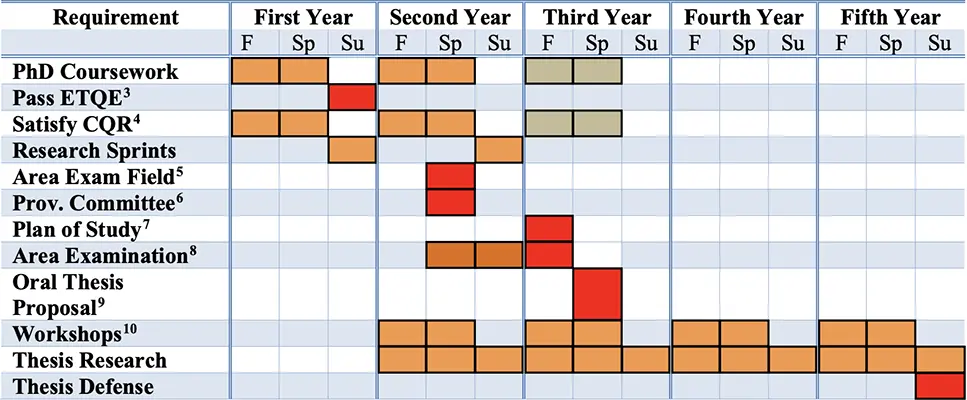
The table below provides a graphical summary of key program requirements and expectations surrounding when those requirements are to be completed. Cells in red indicate a deadline; failure to meet such deadlines implies that the student will not remain in good standing within the program. Cells in orange indicate times when the given requirements are expected to be completed. Cells in gray indicate optional extensions of those times (e.g., if a student does not meet quantitative course requirements in the second year, those requirements may be met by auditing the courses in the third year. Furthermore, some methodology / elective requirements may also be taken in the student’s third year).
Please note that the table below is intended to serve as a quick guide; it is incomplete and lacking detail. Students must also read the text below for more information regarding the items enumerated in the table and details on additional program requirements.
Fall Semester
May/June (with a second chance in July/August if necessary)
July
3ETQE refers to the Economic Theory Qualifying Examination.
4CQR refers to Core Qualifying Requirements. See the description below for details.
5By February 15 of the second year of study, the student must declare his / her field for the Area Examination.
6The provisional thesis committee must be formed by February 15 of the student’s second year.
7The PhD Plan of Study form must be completed by the first day of the student’s third year.
8The area examination must be completed by the end of the Fall semester of the student’s third year.
9A workshop presentation of proposed thesis research is required by the end of the Spring semester of the student’s third year.
Throughout each year (timing dependent on the course)
Core Qualifying Requirements: In each core course not covered in the Economic Theory Qualifying Examination (Microeconomics I, II, and III and Macroeconomics I, II, and III), a student’s performance must meet a qualifying standard. Course grades of A- or above automatically meet that standard, and course grades of B- or below automatically fail to meet that standard. Performance between A- and B- will be judged on a case-by-case basis by the course instructor, and students will be informed whether their performance met the qualifying standard. This requirement applies to the required Econometric courses (Econ 670, Econ 671, Econ 672, Econ 673, Econ 674) and Methodology courses (Applied Microeconometrics, Computational Economics, and Research Methods).
A student who does not meet the qualifying standard in a required course must audit ("retake") that course the next time it is offered. For each audit, the student is expected to participate in course activities as required by the instructor of the course, including but not limited to assignments and, exams, or presentations. Performance in such activities must demonstrate to the instructor the student meets the qualifying standard. Initial grades in the required courses will not be changed as a result of the audits.
The student is afforded only one opportunity to audit ("retake") the required core courses. If after a second attempt performance in any of these courses does not meet the qualifying standard, this will be treated as a failure of the Economic Theory Qualifying Examinations (see Section 6a for further details). The student is permitted to submit in writing an appeal to the Economics Policy Committee, which may consider outside information that would be to the benefit of the student.
February (by February 15)
Declaration of Field for Area Preliminary Examination: By February 15 of the second year, each student must: (i) declare the 6-credit hour field sequence (4 for Econometrics) that will form the basis of his/her area examination and (ii) form the provisional thesis committee consisting of three tenure track faculty members that will serve as the area examiners. This area examination is restricted to field course sequences taken in the second year and taught by the economics department. See Section 6c for details.
May
Area Preliminary Examination Proposal must be approved by the area examiners by the end of the spring semester. See Section 6c for details.
July
5-day Research Sprint. This is the second of two research sprints, designed to be a structured, short-term intensive exercise aimed to assist students develop essential research skills early in their program. See Section 6b for details.
August
Formation of Ph.D. plan of study committee and submission of Ph.D. plan of study (see Section 6c for details) by the first day of the fall semester.
Submit "Take-Home" portion of Area Preliminary Examination by the second day of the fall semester.
Re-take "In-Class" portion of Area Preliminary Examination (if necessary)
December (by last day of fall semester)
February or March
Thesis Proposal Defense: Each student must present a thesis proposal to his/her thesis committee during a workshop. This proposal consists of two parts. The first part is a complete original research paper. The goal is that this paper is of sufficient quality (i.e. demonstrates in-depth knowledge of the relevant literature, investigates a specific well-defined research question, understands the significance of the question, and has a well-developed original research component) as to form the first chapter of the dissertation and, with reasonable revisions, be suitable for submission to a journal. The second part of the proposal is a detailed research plan for the remainder of the dissertation. It must appear likely that the proposed research plan will be completed successfully within two years and will yield an acceptable dissertation.
April (by April 30)
During the fourth year of study, the student is expected to continue to work on his / her thesis research, keeping in close contact with his/her thesis advisor and thesis committee members to ensure timely and sufficient progress. The student is expected to have multiple polished papers by the start of their fifth year in the program. The student will continue attending workshops and, if funded, meet all requirements of his / her TA/RA assignments.
January or Earlier
A complete draft of the job market paper must be submitted to the student's thesis committee by the end of January of his or her 4th year in the program. To remain in good standing the draft must be judged "acceptable" by at least three members of the thesis committee. Students with papers that are not ultimately judged to be “acceptable” will not be eligible for funding during the 5th year of the program.
March or Earlier
October
Job Market. A fifth-year student is required to present his/her job market paper at a workshop by October 15. See Section 6e for details.
June
In spring and fall of years 2, 3, 4 and 5, each student must be enrolled in one a workshop course. The workshops are important in terms of providing examples of the research process and different presentation skills, as well as providing exposure to topics and research methods outside one's immediate interests. Enrollment in a workshop involves meeting the following requirements and responsibilities:
All students registered in a workshop must attend at least 6 seminars each semester. This total includes seminars by outside speakers sponsored by the Economics department, by speakers sponsored by the Management Department, by Economics students, and by approved seminars outside of Economics/Management. There are no exceptions. Approval of seminars outside of MGMT / the Department of Economics means that at least one Economics faculty member (typically the student’s advisor) concludes, and then informs the seminar coordinator in writing, that the talk in question is appropriate for counting toward the seminar requirement. Students MUST receive such permission from the faculty member(s) before the seminar has been given; credit sought after-the-fact will not be granted. The endorsing faculty member will also be responsible for verifying seminar participation. Students who do not meet these minimum requirements will receive an incomplete for their course grade. Students should plan ahead so that conflicts or seminar cancellations do not prevent them from meeting this requirement. If you happen to have a teaching conflict, be sure to sit down with the faculty member running the workshop you have registered for at the start of the semester to discuss your options. Students receiving an incomplete will be required to make up their requirement, with two seminars required for each seminar they fall below the requirement.
All students are expected to have coffee and visit with some of our outside speakers during the day of the seminar. This is an opportunity to discuss the presented paper as well as other research including student research. Coffee sessions will be held in the PhD student Basement lounge. To sign up to attend the coffee sessions, contact Mary Schultz. Each student must attend at least 2 coffee sessions each semester and at least 3 students should attend each coffee session.
All students attending a seminar should act professionally. Students should arrive on time, pay attention, and not leave until the seminar has concluded. Doing homework, grading, or reading a newspaper is inappropriate. Students should never use laptops, phones, or other electronic devices during the seminar.
Third year students must present a thesis prospectus seminar during fall or spring semester. You should discuss the timing of your thesis prospectus seminar with your committee members. You should confirm a date with the appropriate workshop coordinator.
Fourth year students must present a paper by March in the spring semester in order to remain in good standing in the Ph.D. program in economics. The paper must present the student’s own research results. In order to avoid end-of-semester bottlenecks, early in the semester you should discuss the timing of your talk with your committee members. You should confirm a date with the appropriate workshop coordinator in advance. The paper must be presented before the end of regular classes, not during exam week. If you plan to be on the job market in your fourth year, you should plan to present your paper by October 15.
Fifth year students must present their job market paper by October 15 in preparation for the job market. Presenting the job market paper earlier provides more time for revision, so you should discuss the timing of your job market presentation with your committee members starting Sept. 1. You should confirm a date with the appropriate workshop coordinator as soon as possible.
This section explains the general policy concerning the Economic Theory Qualifying Examination and is meant to make the process more comprehensible – if not less painful – for participants. However, explicit rules governing the Examining Committee may change from time to time. In mid-January, the PhD Office will provide each first-year Econ PhD student with copies of the exams from previous years. Note: the exam format changed after summer 2017.
Economic Theory Qualifying Exams are not intended purely as reviews of corresponding course material. While fairly direct questions on standard course material are possible, questions might also cover either unfamiliar applications of basic principles and techniques or topics that are important as theoretical tools but which might have been omitted in coursework. The purpose of the exam is to yield information (a) as to whether it is in the best interests of both student and department to permit a student to continue progress to the thesis stage, and – given a positive answer to (a) – (b) how best to help/encourage the student to have a strong foundation prior to embarking on a thesis. Thus the written exams are intended to reveal breadth and depth of theoretical foundations and economic intuition (both by covering core course material and by introducing variations on core material), and to give information about other skills (such as flexibility, care and organization of exposition, confidence) that are valuable in undertaking a thesis.
The Qualifying Examination consists of two parts, each 4.5 hours long. Each part covers three courses.
Each part of the exam will consist of three sections, with each section based on one of the courses covered in that part. A section might consist of a single multi-part question or several separate questions. Each section of a part of the exam carries equal weight in the grading of that part.
The initial Qualifying Examination is given during the second or third week of the twelve-week summer session in May/June after final exams. For those who do not pass the initial exam, the retake exam is given during the twelfth week of the summer session. The two parts of the Qualifying Examination are given on Monday and Friday from 9:00 AM to 1:30 PM. The standard order of the parts is: Monday (Econ 606, 607, 609) and Friday (Econ 608, 611, 612).
The target for completion of all grading and final decisions on outcomes is Thursday of the week following the exam.
Each of the three sections of a part of the exam carries equal weight in the grading of that part. Each exam section is graded, independently, by the faculty member who wrote the questions in that section and by one other faculty member. This grading is done “blind” – i.e., with students identified only by number.
Scores for individual sections are on a scale from 0 to 100 and are based on the following criteria:
May/June Outcome Criteria:
July/August Outcome Criteria if Retaking Only One Part:
July/August Outcome Criteria if Retaking Both Parts:
There is a formal rule that, without special exemption from the Economics Policy Committee, a student may not continue to the thesis-writing stage of the program unless the student has passed the Economic Theory Qualifying Examination before the start of the second year of the program. Thus, failing the retake is prima facie a signal of impending departure from the PhD program. If the final outcome is failure, the student may submit in writing an appeal to the Economics Policy Committee, which may consider outside information that would be to the benefit of the student. In any case, the student will be allowed to complete a master’s degree in the fall semester of the second year.
Solutions to the written exam questions will not be posted, and graders will not comment on the grades given or solutions to the problems. It is solely up to the student to determine any errors made in his/her written exam answers and to discover the correct answers.
The Doctoral Office will return copies of a student’s exam answers to the student only after receiving a written request from the Theory Prelim Chairperson. Such written requests will be made under the following limited circumstances:
a. Only for students who have failed the exam for the first time and who ask for a copy;
b. Only for “clean” copies of the original exam answers with no grader marks or comments;
c. Only for personal use by the student.
The graders have been instructed not to comment on the grades given to any question. Only a designated Theory Prelim Chairperson can provide information to the student regarding the general quality of answers [and this is done as part of the notification of failure on the written exam]. The student cannot refer to any portion of his or her exam in any appeal procedure to either the Examining Committee or the Economics Policy Committee.
Research sprints are structured, short-term intensive exercises designed to help PhD students develop essential research skills early in their program. These sprints occur at two points in time: a three-day research sprint during the summer of the first year and a five-day research sprint during the summer of the second year. Both of these activities will take place in June after the qualifying exams.
a) First year summer (June). The three-day sprint provides students with a well-defined research problem. In teams, students will investigate and identify relevant data, academic sources and papers, and conduct preliminary analysis and present their findings.
b) Second year summer (June). The five-day sprint allows students working in teams to formulate their own research questions, build theoretical models, identify relevant data, and explore appropriate methodologies.
The objective of these sprints is to foster teamwork, improve students' ability to apply economic tools in research and increase faculty-student engagement. By integrating research sprints into the PhD program, students gain hands-on experience in problem formulation, literature review, data analysis and academic presentation, helping them transition more effectively into independent research.
In February, each second-year PhD student must specify the (typically three-course) economics department field in which he/she will take the area exam and form a provisional thesis committee. In May, each second-year PhD student must submit an area exam proposal.
By February 15, each student must form a provisional thesis committee consisting of three members, with one member chairing or two members co-chairing the committee. For example, the provisional thesis committee may consist of two members from the student’s area of interest (with one of those members chairing or both of those members co-chairing the committee) with the Director of Graduate Studies in Economics serving as the third committee member. At least two members of the provisional thesis committee must be within the Department of Economics. This provisional committee should include the faculty members with whom the student expects to pursue thesis research. In most cases, the provisional committee members in the student’s research area will form the core of the actual thesis committee, and the student should craft the committee with an eye toward his/her intended thesis research.
To form a provisional thesis committee, students should discuss their research interests with the prospective committee members and obtain each faculty member's agreement to serve on the committee. Faculty members are not obligated to serve on any particular committee, so it is wise to be well prepared before meeting with any faculty member. In particular, a student needs to consider the match between his/her interests and the faculty member's areas of interest. A provisional committee form will be distributed in Module 3 of the second year.
The faculty members associated with each area are listed in Section 2. The areas include not only the usual fields offered but also additional areas that might be the focus of a student's thesis. This should aid in the formation of provisional thesis committees.
The field chosen for the area exam must reflect an approved sequence of field courses taught in the economics department. In special circumstances, a student may petition to have economics courses that do not form a regular field combined to form a field for the area exam. If you are considering this, you must discuss the idea with the Director of Graduate Studies in Economics and receive support for doing so from your provisional committee chairperson/chairpersons.
The area exam consists of two parts, an "in-class" part and a "take-home" part. Both must be completed successfully to pass the exam.
-- The "in-class" exam
The "in-class" part of the exam consists of a written examination similar to the theory qualifier, but on the course material covered in the field courses comprising the area. It is administered by the faculty members who taught the courses used to make up the field. A student is exempt from the "in-class" part if grades for at least 4 credit hours of the courses are A- or higher and no grade is B- or lower. If the "in-class" exam is unsatisfactory, it may be retaken, subject to the constraint that it must be passed by the end of the fall semester of the third year of study.
Please note that it is our expectation that the “in-class” portion of the area exam will be waived, as we expect that the student will have earned satisfactory grades in the field courses. Failing to meet the grade requirements within the field courses may provide a signal that the particular field of study may not be ideal for further inquiry.
-- The "take-home" exam
The area examiners for the "take-home" exam consist of the provisional thesis committee chosen by the student. Students must discuss their area exams with potential "take-home" examiners; we assume this discussion would take place in concert with discussions surrounding the formation of the provisional thesis committee. Once faculty members agree to serve as area examiners, they indicate their participation by signing the field declaration form submitted by the student.
By the beginning of module 4, in consultation with his/her area examiner(s), each student should choose an area of literature to investigate in the "take-home" part of the area exam. The precise format of the "take-home" exam will depend on the student and faculty members involved. By the last day of classes in the second year, each student must submit a short (one or two page) “take home” area-exam proposal. A primary objective of the required area examination preparation course is to provide guidance in the development of this proposal, which includes:
State the question or problem to be addressed and its place in the literature.
Describe the methods to be used to address the question, including identification of data sets, if required, with variables necessary to conduct the empirical analysis.
Identify what needs to be done to complete the “take-home” portion of the area exam.
The “take-home” portion of the area exam must be completed before the second day of classes in the fall semester of the third year. To pass the “take-home” portion of the area exam, a student must receive faculty approval (by the area examiners) that the conditions described in the proposal have been satisfied.
The final version of the paper will be assessed by the student's area examiners. The outcome of the assessment will include one of the following recommendations:
That the student advance to the next stage of the PhD degree.
That the student revises the “take-home” portion of the area exam.
That the student be terminated from the PhD program.
Any revisions to the “take-home” portion of the area exam must be completed by the last day of classes in the fall semester of the third year. Only one round of revisions is allowed. Students are, therefore, strongly encouraged to begin work early in their second year on the area examination, thus allowing adequate time to revise and refine the work, as needed. Such work may vary by field but will often include presenting the area-exam proposal in the brown bag series of the field of the area exam and, by July, providing the area examiners with a rough draft of the area exam that includes the empirical/theoretical work.
-- Area exam outcome
If a student does not pass both the "in-class" and “take-home” portions of the area exam by the end of the fall semester of the third year, the student will have failed the area exam. This is prima facie a signal of impending departure from the Ph.D. program. The student may submit in writing an appeal to the Economics Policy Committee, which may consider outside information that would be to the benefit of the student. In any case, the student will be allowed to continue through the summer after the third year.
A draft of your PhD plan of study is due on or before the first day of the fall semester of your third year in the PhD program in Economics. You should work closely with your major professor(s) in deciding on courses to include and on the composition of the plan of study committee (at least three members from the Department of Economics are required). Faculty members are not obligated to serve on any particular committee, so it is wise to be well prepared before meeting with any faculty member. In particular, a student needs to consider the match between his/her interests and the faculty member's areas of interest.
Not all courses you have taken may be listed on the plan and there are some specific requirements, so please read this information carefully before completing your draft plan of study.
Your PhD plan of study must include a minimum of 50 credit hours of courses you have taken, are taking now, or will take in the approved PhD program in Economics. Unless you have prior approval, no more than 3 of those 50 hours may be independent study (ECON 690) course credits. (Note that regular courses with number 690 are not included in this limit.) Only courses taken for a letter grade ("A", "B", "C") and for which you have earned/will earn at least a "C" may be included on the plan of study. Courses taken for "Pass/No Pass" are not acceptable. Economics Department workshops, for example, 613, 618, and 668, and Thesis Research, 699, cannot be listed. With prior approval of the Economics Policy Committee, your plan may include 500-numbered courses offered by the Economics Department or non-Economics courses. If you were allowed to waive a course, such as ECON 615, and obtained the appropriate signatures on an official waiver form, then you may list the equivalent course you took elsewhere in place of the waived course. Be sure to indicate it is a transfer course.
Courses should be listed under four or five groups/headings: the "Primary" groups of Economic Theory (ECON 606, 607, 608, 609, 611, 612, 614, and 615), Quantitative Economics (ECON 670, 671, 672, 673, and 674), and Methodology along with two or three "Related" groups each consisting of field courses. Your elective courses may be placed under a separate heading of "Elective" or "Other," or included in an appropriate group.
The "Area of Specialization," and the title of the first set of "field" courses usually match.
If you received or will receive a Master's degree in Economics from Purdue, then all the courses you listed on (the final version of) your Master's Plan of Study should indicate “master’s” registration.
Your plan of study must also include an advisory committee that consists of at least three members of the faculty from Economics. Students must discuss their research interests with the prospective committee members and obtain each faculty member's agreement to serve on the committee before including the names on the draft plan of study. The department prefers that the plan of study committee (advisory committee) and final examination committee be consistent.
You do not need to list every course you will take as long as your listed plan meets the requirements. In particular, if you are uncertain about any courses you might take in the future, don't list them unless necessary. This reduces the chance that you will need to file an official revision to your Plan of Study.
Prepare your draft plan carefully. Please make certain that you list course titles exactly as they appear on your grade record, and that you list suffixes on those 690 courses that were not independent studies (e.g., 690M). Also, correctly list the date on which you completed/will complete each course.
Be sure to include the names of the faculty members who will serve as your Ph.D. advisory committee. If two faculty members will serve as major professors, be sure to label each one as a co-chair.
On or before the first day of the fall semester of your third year of graduate study, you must submit the draft version of your plan of study electronically at myPurdue. The Doctoral Programs Office will provide access details. If changes are needed, you will be informed of the necessary changes. Once your draft meets the requirements, you will be told to continue with the final submission. Signatures will be collected electronically. You and your committee members will receive a copy of the plan after it is approved in the Graduate School. (You must meet the conditions that were imposed on you and stated in your letter of admission from the Purdue Graduate School before the Graduate School will approve your plan of study.)
To receive your degree, you must achieve a cumulative grade point average of at least 3.0 in all of your graduate courses, and you must not have any remaining incompletes.
Should you have committee or course changes later, or decide not to take a course listed on your Plan of Study, the plan must be revised, again electronically. See the Doctoral Programs Office for details of the process.
By October of the fifth year of residence, the student should be ready to enter the job market. The first step in a job search is to contact prospective employers. Application letters should be mailed no later than the first week of November. Job information is available from the October and November issues of Job Openings for Economists (JOE) published by the American Economic Association. The student should consult with the Economics Placement Director when preparing a resume and mailing list.
On the basis of his/her qualifications and field of specialization, the student may receive invitations for interviews at the Allied Social Science Associations (ASSA) meeting, which is typically held in early January. Before entering the job market, the student should have several research papers in hand to send to prospective employers. At least one of the papers should indicate substantive progress on the student's dissertation topic as well as his/her future research agenda. According to a survey reported in a recent issue of the Journal of Economic Perspectives, the research papers, together with the candidate's field of specialization and recommendation letters, are the most important factors influencing prospective employers' decisions to schedule an interview. Unless the student is exceptional, previous teaching experience and evidence of excellence in teaching are also important. This is especially true if the student's native language is not English. However, reputation cannot be built overnight. In this sense, the first time the student steps into classroom teaching, he/she begins accumulating capital for the job market.
An interview at the meetings usually lasts 30 minutes. Interviewers look for the candidate's ability to explain his/her current research, the quality of his/her future research agenda, and his/her ability to respond to questions. In order to help the student prepare for these interviews as well as provide the faculty with a chance to evaluate his/her dissertation research and ability to teach before they write recommendation letters, the Economics Department requires the student to present his/her job market paper. In addition, the Economics Placement Director will schedule a mock interview prior to the ASSA meeting.
If, after the ASSA meeting, the student has made the "second cut," campus visits typically begin in January and may last until April. The evaluation process will again concentrate on the clarity of presentation, demonstrated teaching ability, knowledge of the literature, ability to explain technically difficult subjects, and ability to answer questions. At the margin, personality and social skills also affect prospective employers' decisions to extend an offer.
Not all positions are filled through the ASSA meeting. The unsuccessful student should investigate other placement activities in the "secondary market." The Midwest Economics Association meeting, which typically takes place in early April, provides one more chance to meet prospective employers. The student may also consider applying for a visiting position.
A student who is enrolled in the Economics PhD program and is in the second year or beyond is eligible to apply for, and receive, a non-thesis Master of Science degree in Economics upon completion of a minimum of 30 credit hours of courses in the doctoral program.
Economics PhD students with guaranteed departmental funding wishing to pursue a master’s degree outside of the school are encouraged to take a one-year leave of absence and to obtain funding from the degree-granting department. Any student in good standing who (1) has guaranteed departmental funding at the time that he or she enters the outside degree program and (2) remains in good standing in the outside degree program shall be readmitted into the economics Ph.D. program and shall be entitled to the unused portion of his or her funding guarantee, subject to the standard rules applicable to that guarantee.
Economics PhD students wishing to obtain a Graduate Certificate in Applied Statistics may do so while enrolled in the economics PhD program as long as no more than one course is taken outside the school in any spring or fall semester. The graduate certificate program requires 12 credit hours of statistics courses taken from a specified list. Check with the Statistics Department for details.
Economics Policy Committee
It comprises all the economics faculty members.
Economic Theory Qualifying Examining Committee, also known as Theory Prelim Committee
The committee that determines the outcome of a student's Economic Theory Qualifying Examination. It comprises instructors of the courses covered under the examination and is chaired by the Director of Graduate Studies in Economics.
Provisional Thesis Committee, also known as Area Exam Committee or Area Preliminary Exam Committee
The committee that determines the outcome of the take-home part of a student's area preliminary exam. It comprises three members with at least two from the Department of Economics. The Director of Graduate Studies in Economics may serve as a committee member.
Plan of Study Committee, also known as Advisory Committee
The committee that a student lists on his/her plan of study to guide his/her course selection beyond the second year. It comprises at least three members from the Department of Economics.
Doctoral Final Examination Committee, also known as Thesis Committee or Dissertation Committee
The committee that determines the outcome of a student's dissertation defense. It comprises at least four faculty members, with at least three from the Department of Economics. The Department prefers that the plan of study committee (advisory committee) and final examination committee be consistent.