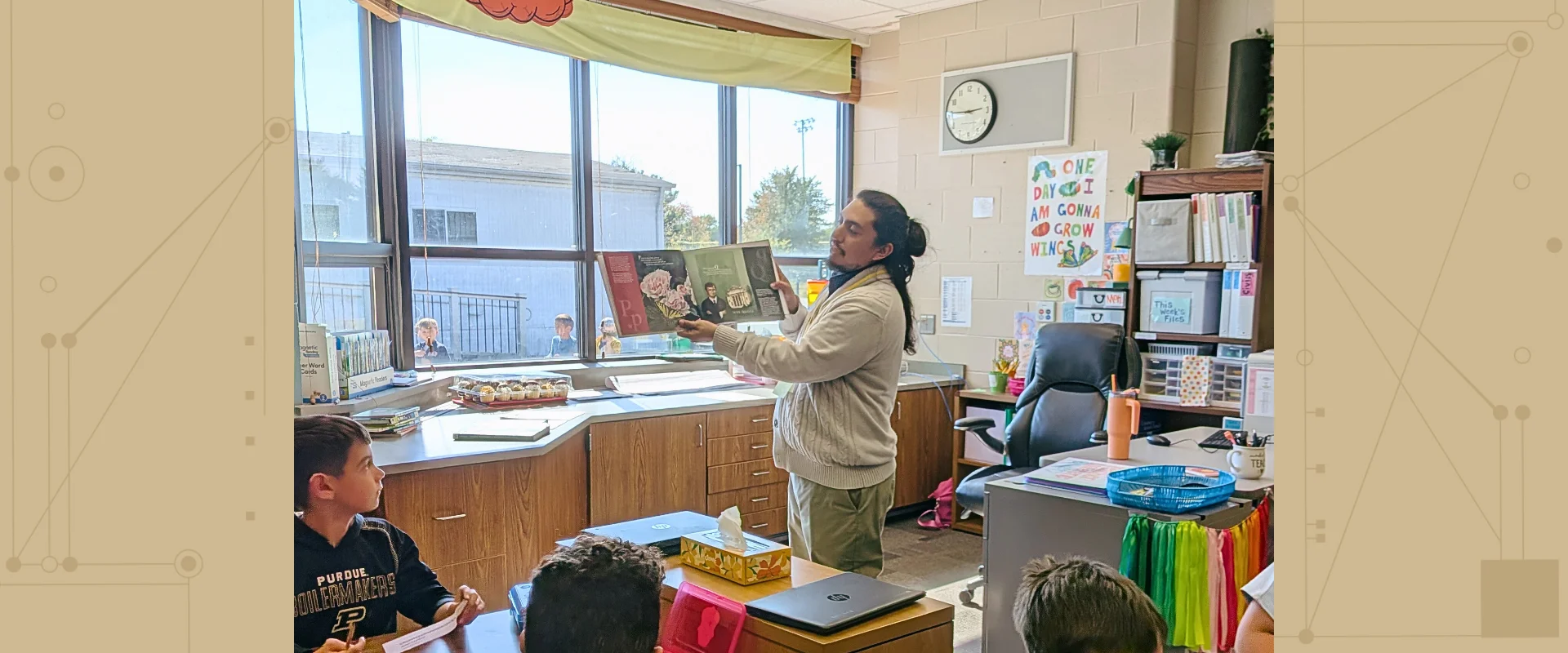
In classrooms across north central Indiana, Purdue University’s new EconReads program is turning story time into an engaging introduction to economics — and showing that even young children can understand ideas like goods and services, producers and consumers, and different types of resources.
Developed by the Purdue Center for Economic Education (PCEE) in the Mitch Daniels School of Business, EconReads brings trained volunteers into kindergarten through second-grade classrooms to read children’s books with economic themes and lead simple, hands-on lessons.
“Economics is in the world around them — and it can be exciting, creative and fun,” says Erin Yetter, PCEE director and clinical assistant professor of economics. “We want students to see that they already use economic thinking in their daily lives.”
Yetter launched the program in Indiana in 2025 after learning about the initiative from the Arizona Council on Economic Education. “When I came on board, I wanted to expand what we offer,” she says. “This was a way to reach young learners in a meaningful way.”
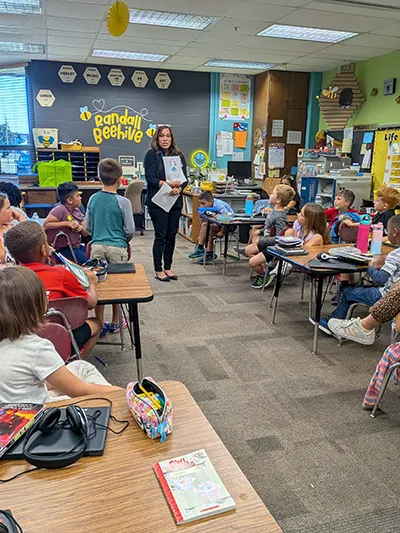
The response exceeded expectations. In its first year, EconReads reached 723 students in 37 classrooms across eight schools in Tippecanoe and Montgomery counties. It drew 37 volunteers from five financial institutions — Regions Bank, Purdue Federal Credit Union, Horizon Bank, First Farmers Bank & Trust and Hoosier Heartland State Bank (HHSB). Two members of the Daniels School economics faculty, Todd Yarborough and Ben Goedeck, also volunteered for the program.
“It took a lot of coordination to get it going, but the response from both schools and volunteers was even stronger than I expected,” Yetter says.
Each EconReads session lasts 45 to 60 minutes and features a book chosen by Yetter to align with Indiana’s K–2 social studies standards. Kindergartners read Career Day, which explores community roles; first-graders learn about goods and services through Dr. Seuss’s ABCs; and second-graders reinforce economic concepts while learning about Indiana’s history, landmarks, events and people using H is for Hoosier.
“I picked the books myself and wrote or adapted the lessons,” Yetter says. “That was important because teachers need to know we’re helping them meet state standards.”
In the Dr. Seuss lesson, students receive small tubs of Play-Doh and create something of their own, like a bracelet, animal or toy. “They make something, then walk around the room to see what their classmates made,” Yetter says. “We tell them their sculptures are goods, and when they were making them, they were providing a service. It’s simple, but it really clicks.”
Teachers and volunteers alike have praised the program’s hands-on approach.
“The students were highly engaged throughout the activities,” says Ashley Randall, a second-grade teacher at Burnett Creek Elementary School. “It was rewarding to see them apply what they learned and ask thoughtful questions.” Volunteers echoed that enthusiasm. “They had a great time and immediately asked when we were doing it again,” Yetter says.
“What I love most is watching the kids’ faces light up when they realize economics isn’t abstract — it’s something they already do every day.”
— Erin Yetter, PCEE Director and Clinical Assistant Professor of Economics
“We loved participating in the EconReads program,” says Lacey Rogers, director of marketing at HHSB. “The thought of teaching economics to 6-year-olds was a little unnerving, but the Career Day book and activities were easy to teach and learn. We were surprised at how engaged and curious the kids were — they were excited to talk about what they wanted to be when they grew up and what their parents do for a living. You could see that details from the book clicked with them when going through the activities.”
EconReads launched in October to coincide with National Economic Education Month, but the strong reception may lead to a spring session. “Several teachers told me, ‘We’d love to do it again in February,’” Yetter says. “That’s when students are stuck indoors and ready for something new.”
During visits, volunteers also introduce themselves and share how their jobs relate to the day’s lesson. “For kindergarten, that’s part of the curriculum,” Yetter says. “They’ll say, ‘I work at a bank, and my job is to help people keep their money safe.’ It helps children see how economics connects to the real world.”
For teachers, EconReads blends literacy and economics — two subjects that can be difficult to fit into a packed school day. “If you can teach reading through social studies, you’re hitting two birds with one stone,” Yetter says. “What I love most is watching the kids’ faces light up when they realize economics isn’t abstract — it’s something they already do every day.”
PCEE plans to expand EconReads with new books, more volunteers and additional school partnerships. “When children start learning about choice, scarcity and resources early, they’re more likely to develop sound decision-making and financial awareness as they grow,” Yetter says.
Visit PCEE's website for more information on the EconReads program.