10-20-2025
With the restructuring of the Daniels School of Business, we are standing at the beginning of a rare and valuable opportunity. The restructuring has given each department the space and freedom to define its own destiny, to set its own mission and to pursue innovation with fewer constraints. For finance, this moment is especially energizing. We are not only shaping the future of our own field, but we are contributing to the larger mission of the Daniels School — to build the future of business.
This new structure gives us greater agility and visibility. Department heads now have direct access to leadership at the dean’s office and the provost’s office, giving finance a distinct and influential voice across the school and the university. That access matters: It allows us to champion initiatives that have tangible impact for our undergraduates, master’s students, PhD students and alumni. We are the largest major at the Daniels School, and we are growing quickly. That responsibility compels us to think boldly and act decisively.
My path to this leadership role has been shaped by a range of experiences across disciplines and geographies. I began with an undergraduate degree in engineering, followed by an MBA, then came to Purdue as a graduate student, earning my master’s in economics and a PhD in finance. After graduating, I taught at Virginia Tech, spent time at the University of Michigan, and then returned to Purdue in 2007 as an associate professor.
Having been both a student and faculty member at Purdue, I know the history and the heart of the Daniels School. I have served in leadership roles within finance and collaborated broadly across departments. These experiences — combined with my time at other top universities — give me both institutional knowledge and perspective on what it takes to build a program that can compete on a national stage.
One of our central goals is to further strengthen a high-performance research culture. Our faculty have always been exceptionally productive, consistently publishing in the leading finance journals and making significant contributions to the profession. Based on per-capita research productivity, we are one of the top finance departments in the Big Ten. I want us to build on that momentum — not only by sustaining our research excellence, but also by ensuring that research excellence flows into the classroom and beyond.
Equally important is creating an exceptional student experience. We want every student, from undergraduate to PhD, to feel immense pride in being a Purdue graduate. Achieving that means innovating our curriculum, investing in teaching excellence and building strong pipelines between the classroom and the job market. Our students should graduate not only with deep technical expertise but also with the applied and soft skills needed to excel in today’s business environment.
Finance is evolving rapidly. Artificial intelligence, machine learning and digital assets are reshaping our field and redefining the skills our students need. While we remain deeply committed to the fundamentals of corporate finance, investments and risk management, we are also integrating these cutting-edge tools and approaches into our curriculum. We are working closely with our alumni and industry leaders to ensure that our curriculum and training keep pace with the rapid changes reshaping finance, equipping our students to thrive in a dynamic and demanding environment.
For example, we have revised our undergraduate curriculum to ensure that all finance majors are introduced to the discipline during their freshman year, with courses supported by active industry engagement. We have launched the Investment Banking Academy to connect our students with alumni and practitioners and to prepare them for highly competitive roles. And this is only the beginning. We are already exploring additional academies in areas like wealth and asset management, as well as certifications and professional affiliations, that will give our students an even greater competitive edge.
At the master’s level, we are undertaking innovative changes as well. The Finance master's program is being revised to integrate advanced analytical training with a dedicated finance-and-AI track, while further strengthening our corporate finance and wealth and asset management tracks. These enhancements will allow our graduates to master the foundations of finance while also positioning themselves at the forefront of emerging industry trends.
One might say that a risk of restructuring into smaller departments is a potential loss of cohesion, but at the Daniels School we are embracing the opposite approach — collaboration as a force multiplier. The Finance Department has already partnered with accounting, economics, strategic management and MIS faculty, and we are in active talks to expand collaborations across campus. Joint projects, co-taught courses and interdisciplinary research will ensure that our department remains connected within the university and relevant to the broader academic and professional community.
What excites me most is the potential to align all of these pieces — world-class research, forward-looking curriculum, industry engagement and cross-campus collaboration — into a coherent strategy that truly builds the future of business. By doing so, we will elevate the Finance Department, strengthen the Daniels School and provide our students with an education that prepares them not just for their first job, but for leadership roles in a constantly changing business environment.
As a proud Purdue graduate myself, I want our students to walk away with the same pride I feel. This restructuring has given us the freedom and responsibility to chart our own path forward, and I am both humbled and energized to help lead that journey.
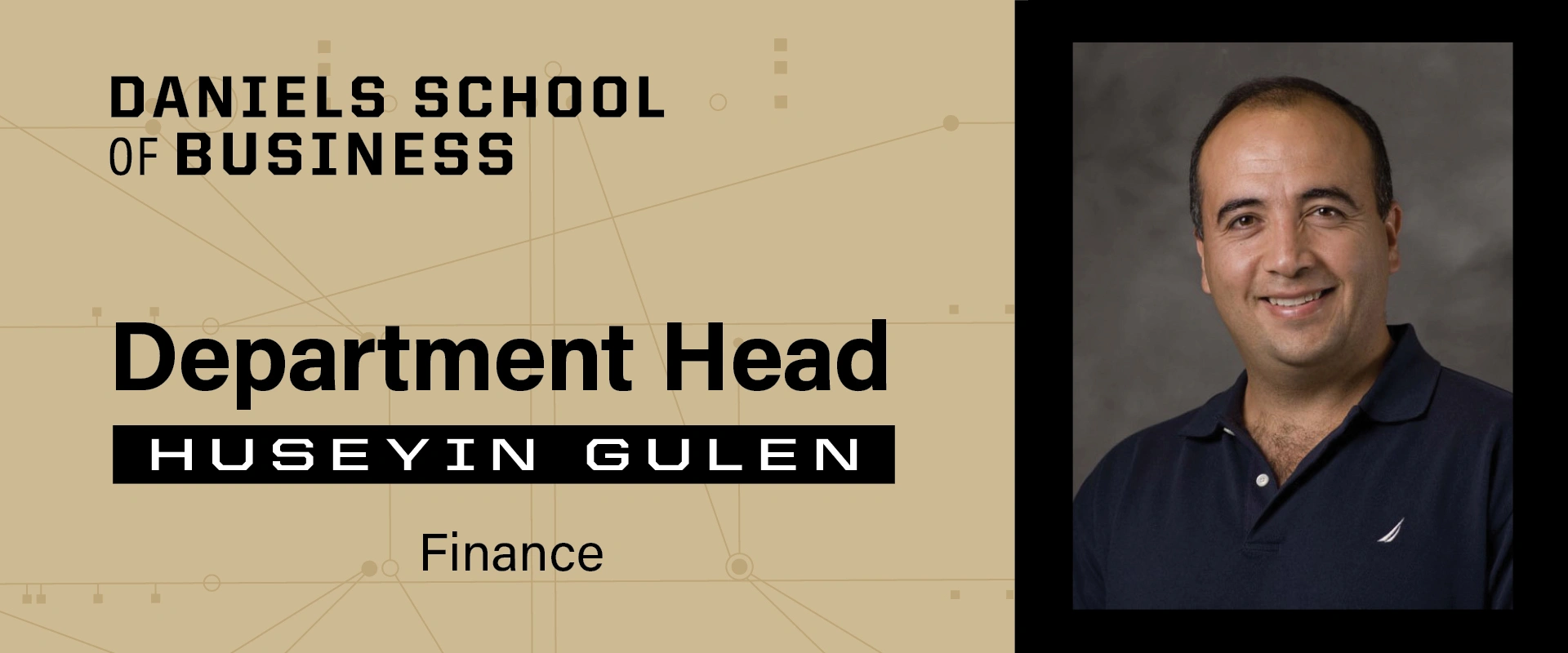
Huseyin Gulen is Professor and Department head of Finance at the Daniels School of Business. His research spans empirical asset pricing, corporate finance and behavioral finance, with influential work on stock-return predictability, political uncertainty, investor beliefs and credit cycles. He has published in leading journals such as the Journal of Finance, Journal of Financial Economics, and Review of Financial Studies. His work has been recognized with awards, including the Jack Treynor Prize, and has been widely cited in both academic and popular outlets, with 12,000 Google Scholar citations and frequent coverage in The Wall Street Journal, The New York Times and others. He earned his PhD in Finance from Purdue University and is a dedicated teacher and mentor across undergraduate, MBA and PhD programs.