02-24-2026
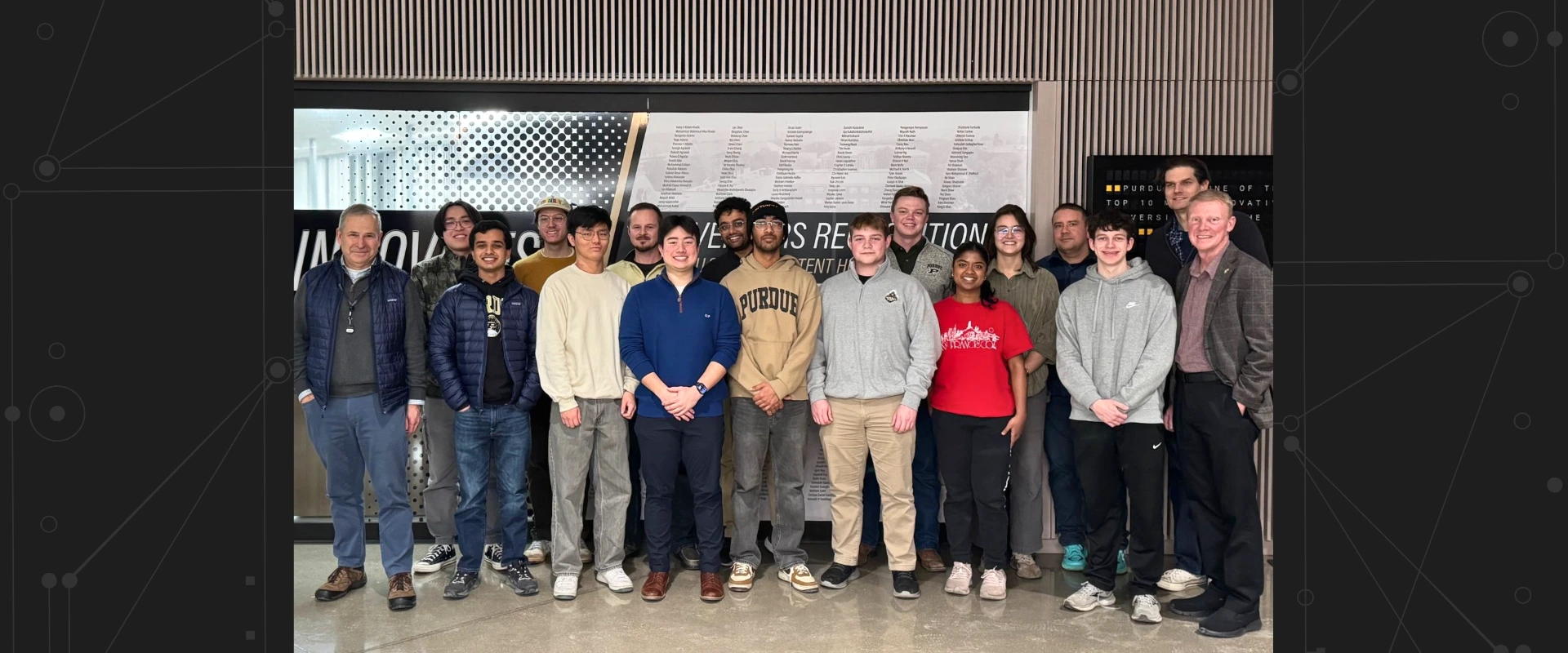
The Daniels School of Business is putting students on the front lines of national security innovation with its new Hacking for Defense course, a hands-on learning opportunity that pairs entrepreneurship training with real problems from the U.S. defense and intelligence communities. Cross-listed with several Purdue colleges and schools, the course launched this spring with 17 students from engineering, business, computer science and cybersecurity working together in interdisciplinary teams.
Hacking for Defense, or H4D, was first developed and taught at Stanford University and has proven successful with a broad array of learners, from experienced scientists and MBAs to undergraduate STEM students. It is essentially a hands-on lab where most learning happens outside the classroom as students interview stakeholders and iterate solutions.
Led by instructor Ken Callahan, a recently retired U.S. Air Force colonel, students tackle challenges sourced from the Department of War, the intelligence community, the Department of State and other agencies. They use the Lean LaunchPad methodology to test hypotheses and rapidly refine potential technologies or concepts, and organize their work through a Mission Model Canvas.
For business school graduate student Greg Sapp (MBT ’26), also a U.S. Air Force veteran, the course represents a rare opportunity to connect mission-driven work with innovation.
“It’s one of the few Purdue experiences where mission, technology and commercialization happen in the same room — with real problem owners and real constraints,” Sapp says. He adds that H4D offers “a disciplined method for turning sponsor-defined problems into transition-ready solutions, backed by measurable outcomes and a credible path to funding.”
Executive Advisor for Innovation and Entrepreneurship Rich Sikora, a co-instructor for the course, says the Daniels School partnered closely with Purdue Innovates and the Office of Research to make H4D a campus-wide opportunity.
“The colleges of Engineering, Science, and Polytechnic supported us along the way last fall and notably helped by recruiting students for our pilot class this spring,” Sikora says. The inaugural cohort includes six College of Engineering students, three from the Daniels School, three computer science majors in the College of Science and three Polytechnic students studying cybersecurity.
Callahan, who also serves as program director for Purdue’s Defense Civilian Training Corps, says the H4D course supports Purdue’s broader mission and vision to become the premier national security and defense university in the nation. “It joins a growing list of over 20 programs that support the Purdue national defense ecosystem,” he says. “Whether it is education, innovation or service, Purdue does it all. H4D fits nicely into this conceptual framework.”
“Purdue Innovates helps deliver the course and extends its impact beyond the semester,” says Brooke Beier, senior vice president of Purdue Innovates. “In addition to supporting the in-course experience, Purdue Innovates will help interested teams advance promising outcomes after the course by providing pathways to startup formation, commercialization and continued development. This creates a meaningful extension of the classroom for Boilermakers with commercialization and entrepreneurial ambitions.”
For Sikora, the course’s appeal to business students is clear.
“All types of students are drawn to experiential project-based learning and the opportunity to solve real-world problems,” he says. “The class is especially attractive to students eyeing careers working directly for the U.S. government and/or companies in the defense security sector, as well as military veterans enrolled at Daniels who want to broaden their future options.” Because the same Lean LaunchPad concepts apply in startups and large corporations, students also gain skills they can carry into private-sector roles.
That combination of government exposure and entrepreneurship was a major draw for Daniels School student Nathaniel Hiatt (BAIM ’26). “This class was the perfect mix of both, offering hands-on experience with government projects in an entrepreneurial setting,” he says. Hiatt, who had not previously considered entrepreneurship, says the course changed his perspective on business education. “Being a business student brings perspective to a group,” he says. “You have less bias toward a specific field and can better look at all possible approaches while working on how to come up with a solution.”
The class design reflects that real-world focus and intensity. Weekly team presentations, blog-style fieldwork reports and a final public presentation account for the vast majority of the grade, and teams are expected to complete at least 10 stakeholder interviews each week while continuously updating their Mission Model Canvas.
In the classroom, a flipped format reserves time for feedback, short lectures and direct coaching, while structured content is delivered online.
“Unlike many entrepreneurship courses, Hacking for Defense does not rely on static case studies,” Sikora says, instead asking students to “learn from encountering chaos and uncertainty” as they engage directly with beneficiaries and partners.
That cross-disciplinary, high-pressure environment is particularly valuable when engineers and scientists team up with business majors. H4D “enables students across academic disciplines to work together on project teams,” Sikora says, and those teams “benefit from the diversity of perspective and solid business acumen our business school students bring to the table.”
For Tomas Ho (BSM ’27, BA Political Science ’27), working across disciplines has made the experience feel closer to a professional consulting environment. “This course is beneficial for business students to gain real-world experience in consulting projects that fulfill a greater objective,” he says. “The defense industry, much less working with the government itself, is far more unique and offers a different skill set. It’s also a class that really allows the navigation of ambiguity and independence.”
Students say the emphasis on interviews and real stakeholder engagement has been one of the most valuable aspects of the course. Hiatt describes the process as “learning how to rapidly learn something new,” noting that students often begin with little technical expertise in their assigned problem. “A large part of the class consists of conducting interviews with the goal of eventually becoming one of the world’s experts in the specific problem assigned,” he says.
Sapp echoes that sentiment, noting that repeated interviews often reshape the original problem. “We have found that while the sponsor’s headline problem is real, the workflow truth is only now beginning to emerge after many stakeholder interviews,” he says. “Adoption far outweighs novelty. The best solution might not be the most advanced technology, but the technology that’s easiest to get in the problem owners’ hands.”
To broaden its impact, Sikora has also asked that H4D count toward Purdue’s Certificate of Entrepreneurship, which is open to students across campus. As the pilot progresses, Purdue and Daniels School leaders hope the course will become a proving ground where students learn to serve both national security and innovation-driven careers.
For Sapp, it represents more than a single course. “I truly believe that Purdue is uniquely positioned to build a pipeline of impact from student teams to the Department of War and other stakeholders,” he says. “H4D is the blueprint.”