07-14-2026
For business students at many schools, consulting projects exist primarily in case studies and classroom simulations. Through a growing partnership between Accenture and Purdue’s Krenicki Center for Business Analytics and Machine Learning in the Mitch Daniels School of Business, students are experiencing something far different: working on real client challenges with real business consequences.
The collaboration places students in project teams led by Krenicki Center faculty and supported by Accenture professionals. Rather than joining existing consulting engagements, students are presented with complex business problems and challenged to develop their own solutions, recommendations and strategic frameworks for the global professional services and consulting company.
According to Scott Uelner, a Purdue business alumnus (BSM ’96) and senior managing director and Americas lead for Accenture's SAP Business Group, that structure is what makes the partnership unique.
The students get something unique: real project experience before they graduate. They're not doing simulated case work; they are embedded in actual Accenture engagements.
Scott Uelner Accenture (BSM '96)
"Accenture brings in a team of students, led by a Krenicki Center professor, presents them with a real client challenge, and asks the student team to come back with a solution," Uelner says. "There's no existing team to blend into, no pre-established point of view, no pre-defined approach to follow. It's a Purdue team of consultants, led and coached by a professor and Accenture lead."
The result is an experience that mirrors the realities of professional consulting while giving organizations fresh perspectives on important business problems.
"The students get something unique: real project experience before they graduate," Uelner says. "They're not doing simulated case work; they are embedded in actual Accenture engagements, working through real constraints and contributing to client deliverables."
That hands-on experience was evident in two recent projects completed through the partnership: Financial Process Transformation and Omnichannel Inventory Optimization.
For faculty lead Davi Cordeiro Moreira, clinical assistant professor and director of the Undergraduate Business Honors Program, the projects provide a level of learning that cannot be replicated in a traditional classroom.
"One of the most compelling aspects of these projects is that they mirror the reality of professional practice," Moreira says. "Students are immersed in real, ongoing business problems where the path forward is often unclear. Solutions emerge gradually through iterative research, development, discussion and decision-making."
The projects require students to combine technical expertise, business acumen, communication skills and teamwork while navigating ambiguity and client expectations.
"The students bring a strong and diverse skill set to this work," Moreira says. "Krenicki students, in particular, contribute complementary strengths in communication, modeling and quantitative analysis. What stands out is how effectively they integrate these skills within a team."
Uelner agrees.
"The students possess curiosity, drive, an eagerness to learn and real AI skills," he says. "They are growing up in AI, embedding it into their day-to-day lives and bringing that to the project work. Combined with solid business fundamentals, it packs an amazing punch."
The projects also challenge students to take ownership of their work.
"The students didn't over-hedge or wait to be told what to think," Uelner says. "They did the analysis, formed a view and defended it when challenged. That's a quality that takes some people years to develop."
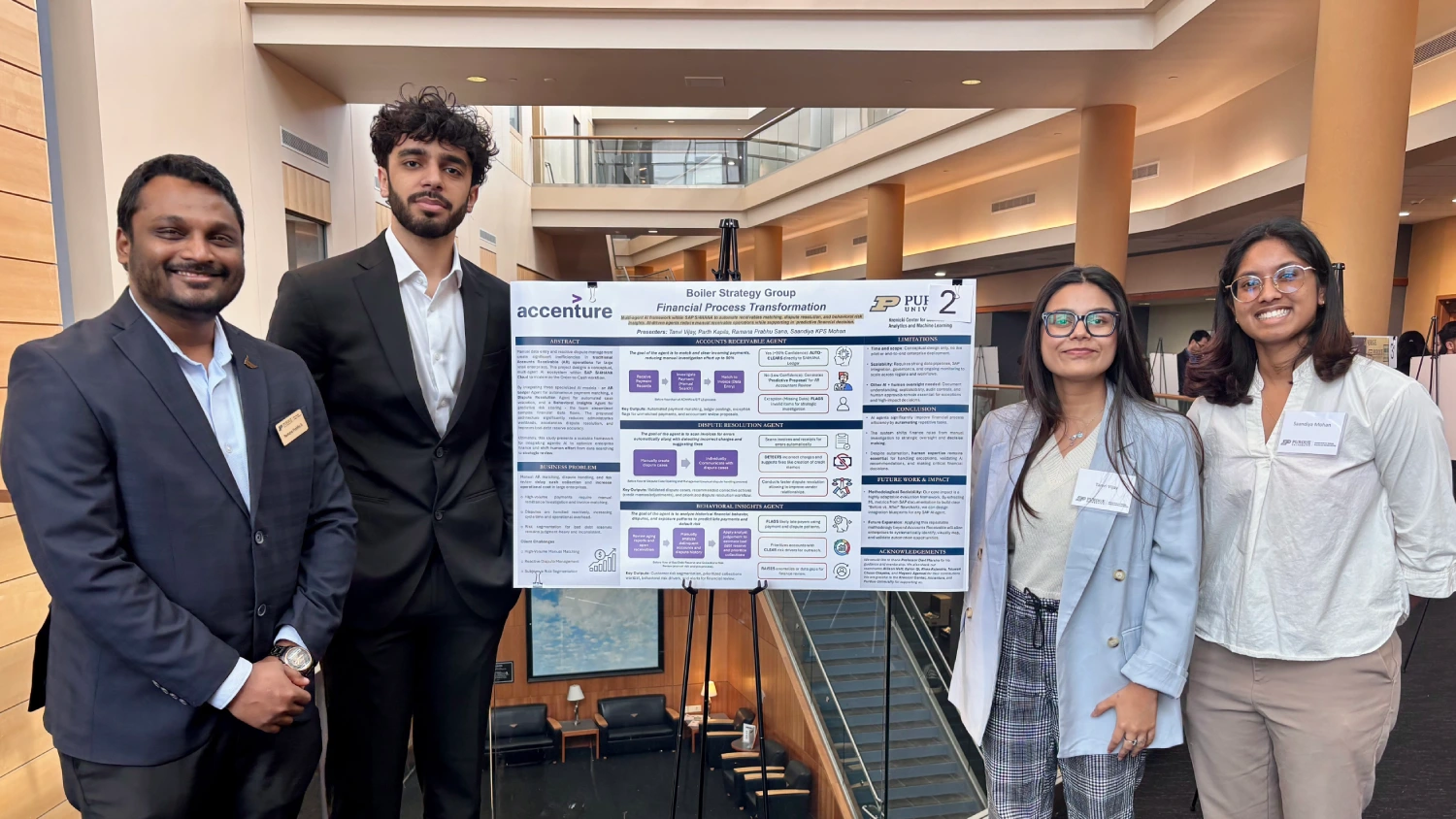
One team partnered with Accenture to explore how artificial intelligence could transform accounts receivable operations for large enterprises.
The project focused on a common challenge facing organizations: manual financial processes that require employees to spend significant time matching payments to invoices, resolving disputes and assessing payment risk. These activities can slow cash collection, increase costs and reduce operational efficiency.
To address the challenge, the students designed a conceptual framework using multiple AI agents within SAP S/4HANA. The proposed system included an accounts receivable agent that automatically matches payments and invoices, a dispute-resolution agent that identifies billing discrepancies and recommends corrective actions, and a behavioral insights agent that analyzes payment histories to predict potential collection issues.
Rather than replacing finance professionals, the framework was designed to automate repetitive work and allow employees to focus on higher-value analysis and decision-making.
Parth Kapila, student lead for the project, says seeing AI applied at an enterprise level was one of the most rewarding aspects of the experience.
"I found it fascinating," Kapila says. "There is rapid growing interest to use AI to automate the manual repetitive work. It's been very exciting to see how removing the mundane tasks can empower corporate teams to step back and stay focused on their higher priority action items."
The team used AI extensively throughout the project to accelerate research, summarize complex documentation and organize client deliverables.
Perhaps most importantly, the students learned that successful AI implementation requires more than simply automating processes.
"A major takeaway for me was that despite the aggressive push for automation, there is still a massive focus on keeping a 'human in the loop,'" Kapila says. "Enterprise-level financial processes require extreme accuracy and risk management, so AI is heavily relied upon as a co-pilot rather than completely replacing humans."
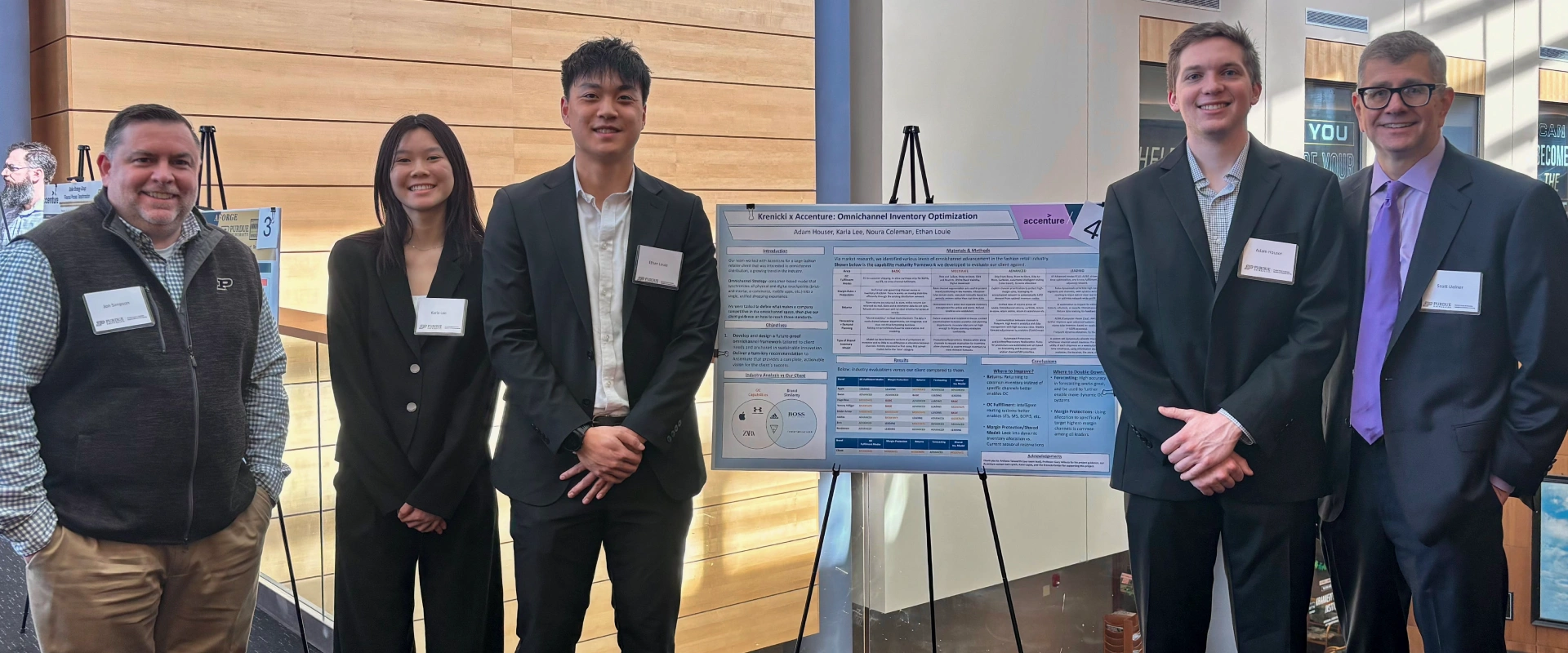
A second team addressed a challenge confronting retailers across the globe: how to effectively manage inventory across stores, e-commerce channels and wholesale operations while meeting rising customer expectations.
Working with Accenture’s client, a global fashion retailer, the students investigated how leading organizations approach shared inventory strategies and omnichannel fulfillment.
The challenge extended well beyond technology.
As consumers increasingly expect seamless experiences — buying online, picking up in store, returning products through multiple channels and receiving rapid delivery — retailers must carefully balance profitability, inventory availability and operational efficiency.
To help the client navigate these complexities, the team conducted extensive market research and developed a proprietary maturity model for evaluating omnichannel capabilities. The framework examined fulfillment methods, margin protection strategies, returns management, forecasting capabilities and shared inventory models.
It's one thing to learn consulting frameworks in a classroom, but watching professionals navigate a real transformation initiative gave me a perspective I couldn't have gotten anywhere else.
Archana Tatavarthi MBT '26
Using the model, students benchmarked leading retailers and identified practices that could help improve the client's omnichannel strategy.
"The project challenged students to address a complex business problem that required them to analyze customer interactions across multiple channels and identify opportunities to improve the overall customer experience," says faculty lead Gary Mercado Velasco, clinical assistant professor and academic director of the MSBAIM program. "Students had to synthesize information from different sources, engage with industry stakeholders and develop recommendations that balanced analytical insights with practical business considerations."
For student lead Archana Tatavarthi, working alongside Accenture consultants provided valuable insight into how large-scale business transformations are managed.
"The most rewarding part was getting direct access to seasoned Accenture consultants and seeing how they structure and approach complex client engagements," Tatavarthi says. "It's one thing to learn consulting frameworks in a classroom, but watching professionals navigate a real transformation initiative gave me a perspective I couldn't have gotten anywhere else."
One of the team's most important discoveries was that omnichannel transformation is fundamentally an organizational challenge. Mercado says he was impressed by the students’ ability to quickly understand a complex business environment and translate data into actionable recommendations. "They demonstrated curiosity, professionalism and a willingness to challenge assumptions," he says. "The team consistently sought feedback, refined their analyses and maintained a client-focused mindset throughout the project."
"What surprised me most was that moving to an omnichannel shared inventory model is not primarily a technology problem," Tatavarthi says. "It is a fundamental rethinking of how a retailer operates across every function."
The team ultimately delivered a comprehensive industry benchmark that helped the client evaluate its current approach and identify opportunities for improvement.
"We delivered an industry view of how leading competitors and comparable retailers are approaching omnichannel inventory transformation, giving the client an external benchmark to pressure-test their own strategy," Tatavarthi says.
While the projects generated valuable insights for clients, faculty and industry partners agree that their greatest impact may be on the students themselves.
Mercado notes that projects like these provide invaluable experiential learning opportunities. Students gain hands-on experience applying analytical techniques to real business challenges while working directly with industry partners, developing skills in stakeholder communication, project management, consulting and executive-level presentations.
"Working with Accenture requires them to integrate multiple skills at once and to perform at a professional level, something impossible to replicate in a traditional classroom environment," Moreira adds.
At the same time, organizations benefit from fresh perspectives and emerging talent.
"The partnership gives Accenture access to motivated, well-prepared students from Purdue’s Daniels School of Business who contribute immediately to real client work while they're still completing their degrees," Uelner says.
As AI, digital transformation and data-driven decision-making continue reshaping industries, experiences like these provide students with something increasingly valuable: the opportunity to solve real business problems before they enter the workforce.
For the students involved, the projects were more than academic exercises. They were opportunities to think like consultants, collaborate like professionals and deliver solutions that could help shape the future of business.
Companies interested in partnering with the Daniels School of Business on consulting-focused business analytics projects can contact the Krenicki Center for Business Analytics and Machine Learning for more information.