10-05-2026
Artificial intelligence is reshaping the nature of work across industries, including financial services. But rather than viewing AI as a threat, John Waldron, president and chief operating officer at Goldman Sachs, encouraged Daniels School of Business students to see the technology as an opportunity to become more capable, adaptable professionals.
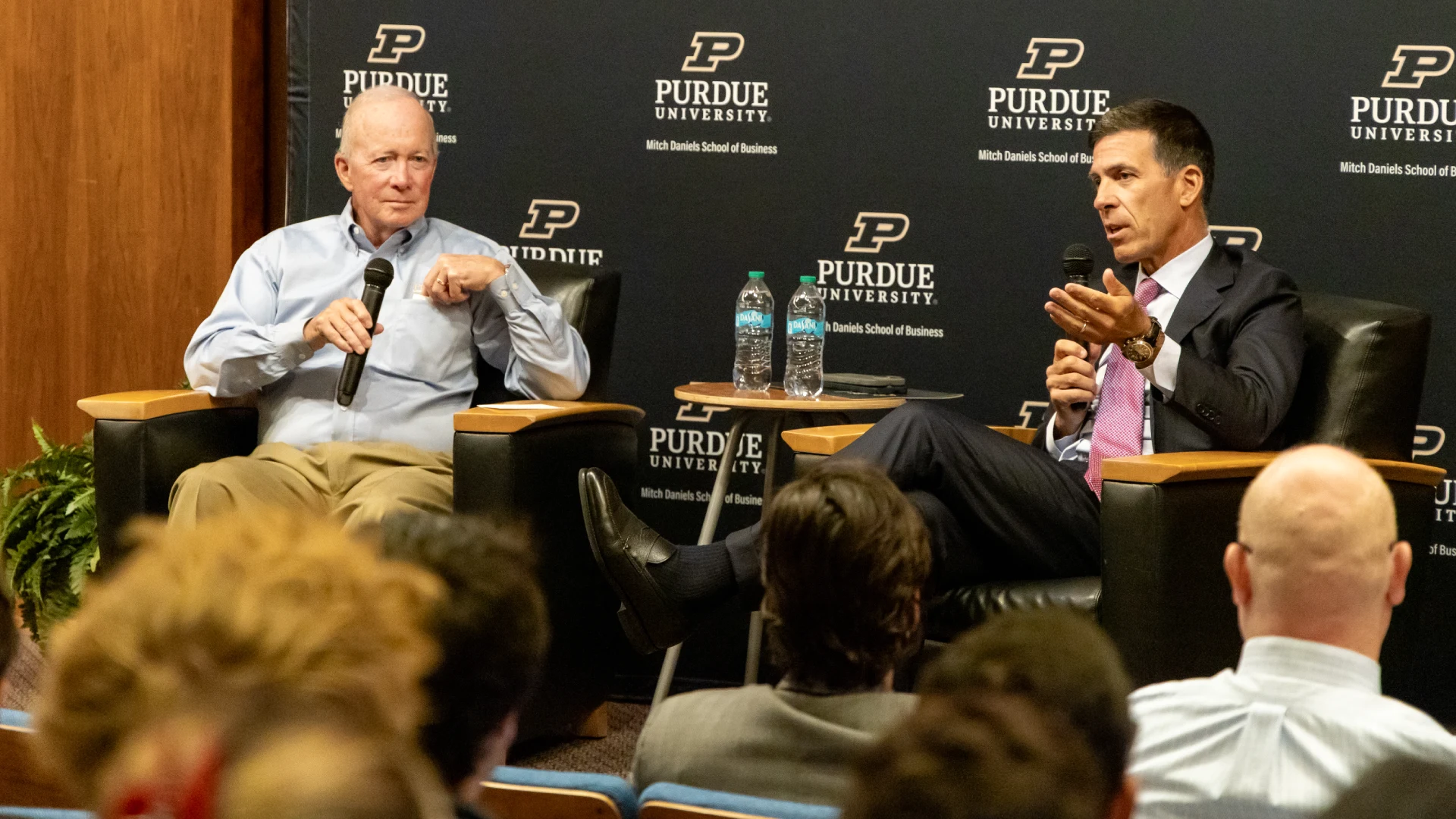
Waldron recently sat down with Purdue interim President Mitch Daniels to discuss careers in financial services, the changing nature of entry-level work and how students can prepare for an increasingly AI-driven workforce. Daniels called the visit “a rare opportunity for us to have one of the world’s leading business executives here on campus.”
Rich Ryffel, special advisor to the dean and professor of practice, organized the event and sees the convergence of technology and business as a particular opportunity for Purdue business school students.
“Between Purdue’s STEM education foundation and the trustees’ new AI competency graduation requirement, Purdue students are uniquely positioned to bring AI skills to those firms that are both undergoing the most AI-driven change and being presented with huge AI challenges and potential,” Ryffel said.
For Waldron, the future of work isn’t about AI replacing people. While some jobs and tasks will disappear as technology takes over work once done by humans, he said, AI will also create new opportunities and reshape existing roles.
“We don’t think this is a job apocalypse. We actually believe that it’s going to create a lot of new jobs,” Waldron said.
That transformation is already influencing how Goldman Sachs thinks about the work of its roughly 46,000 employees, including over 10,000 engineers, Waldron said. AI can take on repetitive and information-heavy tasks, freeing early-career employees to spend less time gathering and organizing information and more time thinking about what it means.
For a junior banker, that could mean more opportunities to attend client meetings, ask questions, listen to senior colleagues and develop the judgment that comes with experience.
Rather than eliminating the apprenticeship model that has long helped young professionals learn the business, Waldron said AI could strengthen it. “The apprenticeship model is fundamental,” he said, adding that AI could make it “better, faster, more comprehensive, more valuable.”
The shift in how young professionals learn on the job also affects what students should focus on as they prepare for their careers. Waldron encouraged students to stay curious about AI, experiment with different tools and grow comfortable using one or two models — familiarity he said will help them understand how AI can sharpen their own abilities.
The students who adapt best, Waldron said, won’t necessarily be the most technically skilled but those most willing to learn, experiment and embrace change.
That mindset matters especially in financial services, where technical and business skills increasingly overlap. Waldron pointed to growing opportunities for engineers as Goldman Sachs invests in data, cloud technology and AI-driven tools — but he said technical skills alone aren’t enough. Engineers also need to understand finance and the business problems they’re helping to solve. “You need to blend engineering and finance,” Waldron said.
Daniels School degree programs are built around this idea of blending, giving students a STEM-infused, interdisciplinary education that prepares them for the kind of roles Waldron described. Daniels highlighted one undergraduate program.
"Our integrated business and engineering program has been a massive success, oversubscribed from its very inception,” Daniels said.
Ryffel sees that blend as a strength Daniels School students can bring to the industry. “Goldman and other financial services firms are in the midst of an AI revolution, and our students are uniquely qualified to bring tech savvy, rigorous finance and computer science training, AI facility and experiential learning to Wall Street, Y’all Street and elsewhere,” he said.
Waldron’s own career offers another lesson for students navigating a changing workforce. An English major at Middlebury College, he initially planned to become a writer before coursework in accounting and a business program at the University of Chicago introduced him to finance.
That path shaped his view of what makes professionals effective: not only technical skill but the human qualities that come with it.
“The best combination of skills is people who understand mathematics, understand finance ... and have logical thinking but also have the softer human elements — good listening skills, communication skills,” Waldron said.
Those skills, he added, will matter regardless of how fast technology advances. “No amount of AI is going to make our relationships better.”
For students entering the workforce, the takeaway isn’t to predict exactly which jobs AI will create or eliminate, it is to keep learning as the work evolves. They must build technological fluency while strengthening the judgment, curiosity and human connection that make new tools worth using.
Watch President Daniels' conversation with John Waldron: