
Gail Farnsley built a CIO-level career and along the way, she made her leadership a service to others. Now she shares the lessons and tools that helped her make wise decisions about the hard tradeoffs.
She arrived in the United States as a child, the daughter of a carpenter and a waitress, in a community where “I didn’t know anybody who went to college.” A high-school teacher, David Brewer, pushed her toward post-secondary education and computer science. “If he hadn’t encouraged me, I don’t know what I would have done,” Farnsley, a first-generation college student, says.
She graduated in the early 1980s from a computer science program that was over 40 percent women. When she started her career, women were almost nonexistent in management; at Georgia-Pacific, she recalls “two of us out of … 20 managers and senior leaders.” That gap sharpened her awareness of career mobility.
Farnsley calls choosing her spouse one of the most pivotal decisions in her life. Her husband, Art, chose to pursue a part-time academic career so he could be the primary parent while she worked “a lot of hours” in executive roles. “With the career I had, it couldn’t be me” at home. Part of the matrix of that joint decision is that her career offered a larger salary. She and Art knew that it could change their family’s opportunities.
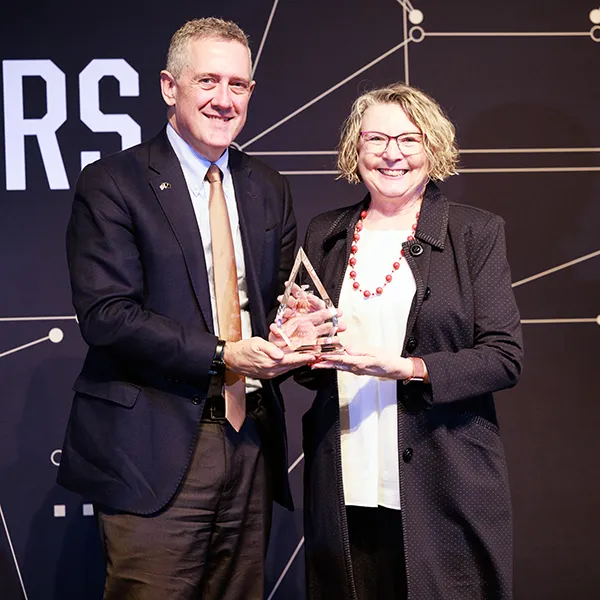
Dean Jim Bullard honored Gail Farnsley with the Distinguished Alumni Award at the 2026 Legacies and Leaders event.
As she moved from Georgia-Pacific to Cummins, she encountered more women leaders — but the few with children all had spouses who ran the household, while she cannot recall men in similar roles whose wives worked full time with kids at home.
From her experience, she advises dual-career couples to address that, “Somebody’s got to be taking care of things at home if you’ve got children.” For young professionals, she recommends they factor that reality into whom to marry and how to negotiate each promotion, move and new baby.
Farnsley borrows a framework from a childcare-center executive who told Cummins parents: if you have kids, you need a “partner in parenting” — someone you can call and say, “I need you to go get the kids,” whether that person is a spouse, relative or friend. Before accepting a demanding role or promotion, she suggests asking “Who is my partner in parenting for the next 12-24 months?” — and if you don’t have an answer yet, your first task is building that support.
In Cummins mentoring circles, Farnsley led groups of women five to eight years into their careers, co-mentoring alongside a male leader. One young woman wanted a promotion that required travel but also longed for a second child. While she felt the angst of the choice, her husband’s question — “Do you want that job or not?” — made the woman realize that, given their current setup, saying yes likely meant one child forever.
Farnsley remembers the tears shed, and she uses that story to insist that grief is part of career design. There is real loss in closing doors on family size, geography or certain trajectories. She emphasizes that both women and men increasingly wrestle with these tradeoffs, but that “you can always make the choices that are right for you — just recognize the implications,” including financial consequences and shifts in identity.
For much of her career, Farnsley’s mentoring grew “by default,” especially when she ran IT for Europe, Middle East, and Africa at Cummins and younger women with children sought her out because they shared challenges their male bosses didn’t face. She later formalized that impulse at Gartner, where she spent a decade as a senior executive partner advising CIOs and their delegates.
Colleagues told her that role required being comfortable “not being the king or queen. Your job is to be the king or queen maker.” She embraced that perspective: “That’s the best part, isn’t it?” At Gartner, she convened six CIO delegates from different organizations into a cohort, running workshops on leadership development plans and pairing people whose strengths and gaps complemented each other. Nearly all of them moved into C-level roles; one in particular reached out to say he had advanced into multiple CIO roles.
“They were all very talented so not surprising,” says Farnsley. “I'm fairly regularly in touch with most of them too, which I love.”
Farnsley describes herself as “a big fan of tools” and “pretty pragmatic”: she wants people to leave a conversation with something they can actually use.
Two tools anchor her approach: a cause-and-effect (Six Sigma) matrix and a one-page life or career plan.
She repurposes a Six Sigma cause-and-effect matrix — originally for mapping process inputs and outputs — to help students and mentees choose between jobs, promotions and relocations. Across the top, they list what matters: salary, type of work, location, travel, time with kids, proximity to family, community involvement, ethical fit, title, prestige and more. Down the side, they list options (Job A, Job B, stay, grad school).
Each cell is scored for impact, revealing patterns: which options support core values and where tradeoffs are steep. She insists that money and prestige belong on the matrix — “those are valid” — because her own executive pay “changed [her] life and [her] children’s lives,” but she pushes mentees to include “softer” priorities so those don’t vanish under compensation alone.

Farnsley encourages couples to each fill out the matrix separately, then compare. When she and Art used it about a potential move, they discovered one factor would have the biggest effect on their quality of life; “once … we did the exercise and talked it through,” it “absolutely changed the decision we made,” even though the job and location seemed “really cool.”
From Women in Technology International, she adopted a “one-page plan” format, similar to a corporate strategy on a page: a personal mission, key values or priorities, and specific steps to move toward them. She notes she didn’t develop a specific “mission” until later in her career. Now she uses this exercise with students to keep them from waking up in the same questions as the Talking Heads song, wondering if the “beautiful house” and “beautiful life” is theirs. It’s better to be conscientious about decisions than wondering late in your career, “How did I get here?”
The mission section, she says, usually stays stable because it is grounded in values, while tactics and milestones shift over time as opportunities appear or disappear. She pairs the narrative one-pager with the quantitative matrix: “the verbiage” sets direction, and the spreadsheet helps you see how each decision affects what you say matters.

Farnsley is candid about offers that test your values. She remembers a call from a company offering “an obscene amount of money — just simply obscene,” the kind of job where “if I did it for two years, I wouldn’t have to ever work again.” But she concluded she “couldn’t work at a company like that, doing what they do,” because she felt like she’d be “ripping off every person that you do business with.”
She doesn’t pretend the temptation isn’t real; the internal voice asking, “could I do it for two years?” is part of the story she tells students. Her practical advice is to define non-negotiable lines in advance, ideally in your one-page plan, so when the “obscene” offer appears you can ask not just “what would this buy?” but “could you live with yourself afterwards?”
Drawing on a Gartner workshop she reworked from “You’re the new CIO; now what?” to “Next stop CIO,” Farnsley uses a juggler metaphor: leaders always have “balls laying on the floor,” so the question is which ones the CEO is watching. Many senior failures, she argues, come from mismatched expectations — leaders focus on Y while their CEO expects X — and you then face a choice: “do X and figure out how to do Y in the background,” or “focus on Y and recognize you may get fired if you don’t do X.”
She applies the same logic to life design: your stakeholders — self, partner, kids, employer — will always have conflicting expectations, so success is choosing which balls you’re willing to drop and owning the consequences. With students in Purdue’s Women in Technology course, she summed this up as, “You can do anything, but you can’t do everything,” reminding high-achieving first-years that a Purdue degree will give them abundant options but also more opportunities to over-commit their lives into a corner.
In retirement, she follows her own rules: “I don’t have to do things I don’t like. I don’t have to work or hang out with people I don’t respect or trust.” She has chosen to step back from roles where the organization’s values no longer align with hers.
Farnsley has always been active. Over her career, her servant leadership showed up in joining networks, mentoring women in tech and other leaders, guest teaching at Purdue, advising CIOs and their teams, and serving on boards that let her combine family and service, just as she once did on her daughters’ dance-school board. In her words, the real accomplishments aren’t the IT projects; they’re the moments when a former mentee becomes a CIO and writes to say, “I got to this role” — and she can think, “I had a little part in your life script.”
Read more about Farnsley’s mentoring in her Daniels Insights blog post.